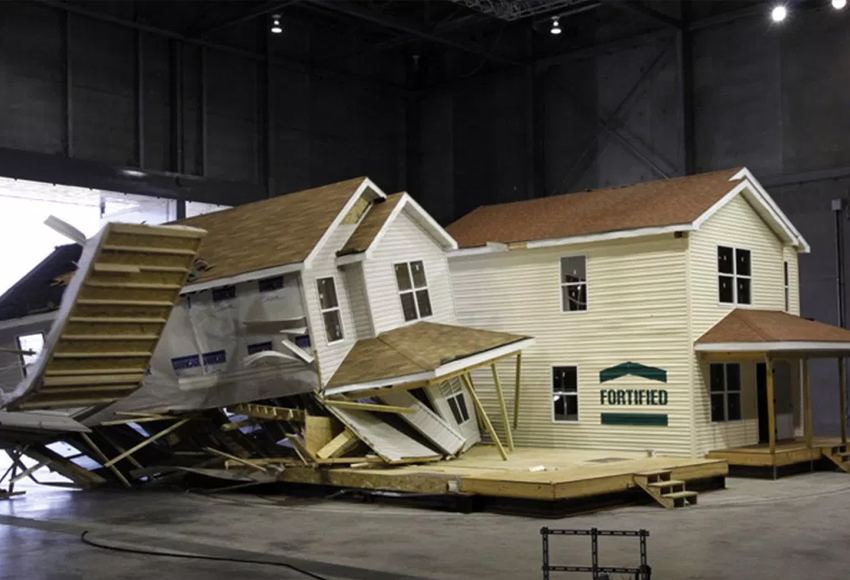
When a hurricane or severe thunderstorm damages a building, the trouble usually starts at the roof. Wind lifts shingles and roof edges, a few pieces of roof deck come loose, and rain pours into the attic and the rooms below. FORTIFIED, a construction standard developed by the Insurance Institute for Business & Home Safety (IBHS), is designed to stop that chain reaction.
Why the roof comes first
Wind does not push evenly on a roof. It creates strong uplift at edges, corners and ridges, where most roof failures begin. Once the covering is gone, an unsealed roof deck lets large amounts of water into the building, and water damage is often more costly than the wind damage itself. That is why the FORTIFIED program starts by focusing on the roof, the most important and vulnerable part of every building.
What a FORTIFIED Roof includes
Exact requirements are set by IBHS and are updated over time, but the FORTIFIED Roof level generally targets these weak points:
- Stronger deck attachment. Roof sheathing fastened with ring-shank nails at closer spacing so panels stay on the house.
- A sealed roof deck. Taped seams or a fully adhered membrane that keeps water out even if shingles are lost.
- Better edges. Drip edge and edge details that resist peeling at the perimeter.
- High-wind-rated covering. Shingles, metal or tile rated and installed for high winds.
- Attention to openings. Vents and penetrations rated and installed so they do not become leaks.
Inland, where hail is a major threat, IBHS also offers requirements for impact-resistant roof coverings.
Beyond the roof: Silver and Gold
FORTIFIED Home has three designation levels. The first level was originally called Bronze and is now called FORTIFIED Roof.
FORTIFIED Roof
The roof system upgrades described above.
Silver
Adds protection for windows, doors and garage doors, bracing for gable ends, and stronger attachment of porches and carports.
Gold
Adds a continuous load path that ties the roof to the walls and the walls to the foundation.
There is also a FORTIFIED Commercial program for new and existing commercial buildings.
The best time to do it: re-roofing
Most of the FORTIFIED Roof work happens at the roof deck, which is exposed anyway when an old roof is torn off. That makes a planned re-roof, or a roof replacement after storm damage, the most practical time to upgrade.
Verification is part of the standard
FORTIFIED is not only a list of materials. It requires documentation that the work was done correctly, and a certified FORTIFIED Evaluator is the only professional who can help a property earn a designation. Plan for the documentation before the roofing crew starts, because some steps, such as deck nailing and seam sealing, are covered up quickly.
Is it worth it?
FORTIFIED is described by IBHS as “code-plus”: it goes beyond the minimum requirements of most building codes. In some states, insurers offer premium discounts for FORTIFIED designations, and some states run grant programs for wind-mitigation upgrades. Ask your insurance agent and check your state’s programs before you plan a project. For the current standard, see fortifiedhome.org.
Martinez & Associates specializes in the fortification of homes and structures in high-risk areas affected by severe weather.